 Best AI for Advisors
AI Portfolio Risk and Proposal Software for Advisors: 5 Tools Compared (2026)
By William Foster, FounderPublished 7 min read
Disclosure: Some links on this page may be affiliate links, which means we may earn a commission at no extra cost to you. Listings are independent and sponsored placements are always labeled. Learn more.
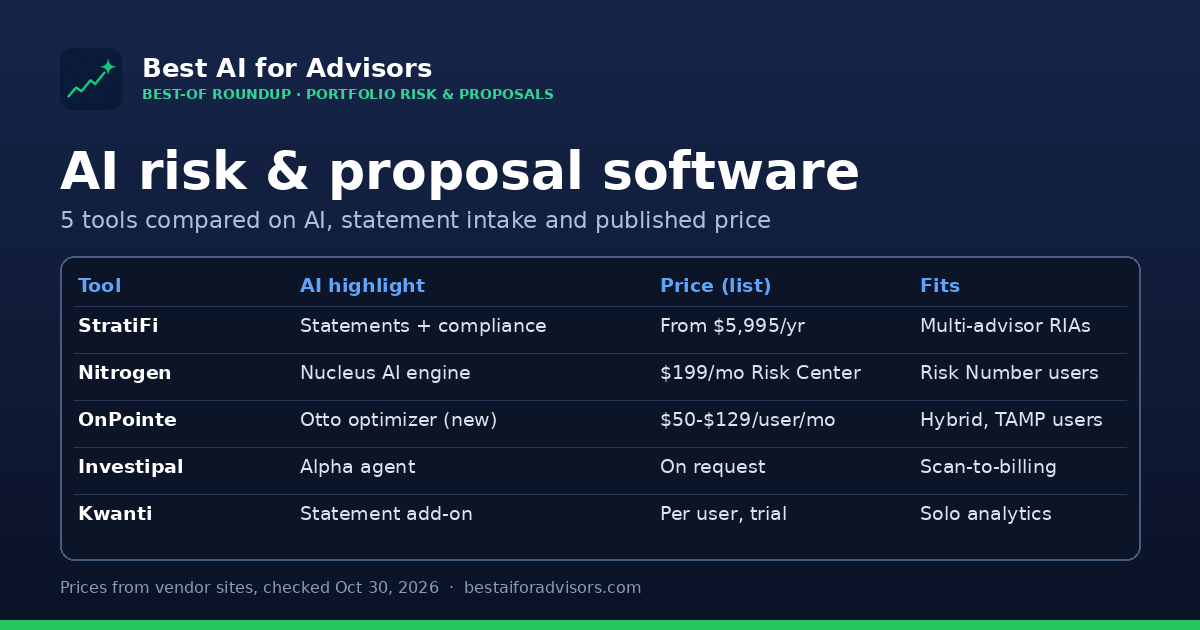
Short answer: For most independent advisors the shortlist is five tools. StratiFi is the strongest statement-to-proposal tool with compliance monitoring and published annual pricing. Nitrogen (formerly Riskalyze) is the default for risk-tolerance conversations, sold Center by Center. OnPointe Software is the lower-cost per-user option and, since October 28, 2026, has Otto, an AI optimizer that builds allocations from your own models. Investipal runs the whole path from statement scan to onboarding and billing, with the Alpha AI agent. Kwanti suits analytics-minded advisors who want white-labeled proposals they can trial first.
Key takeaways
- Published list prices range from $50 per user per month (OnPointe Light) to $39,995 a year (StratiFi Platinum); Investipal quotes on request (all checked October 30, 2026).
- The AI in this category has moved past statement scanning: OnPointe's Otto optimizes across your models and TAMP strategies, and Investipal's Alpha drafts the proposal and the review deck.
- Every vendor says outputs need advisor review. Keep the AI-built proposal, the advisor's changes and the final IPS as records of how the recommendation was made.
What this software does, and where AI now fits
Portfolio risk and proposal software covers one sales-critical workflow: take a prospect's current holdings, score the risk, compare it with the client's stated tolerance, and produce a proposal (and often an investment policy statement) that recommends something better. It is the meeting where a prospect becomes a client, so speed and clarity matter.
AI shows up at three points in that workflow:
- Getting the data in. Reading a PDF or image of a brokerage statement and turning it into holdings, so nobody keys in 40 positions by hand.
- Building the recommendation. Optimizing an allocation against a risk target, or explaining why one portfolio scores better than another in plain English.
- Writing it up. Drafting proposal commentary, the IPS and the review deck from the client's goals and meeting notes.
The five tools below cover all three in different combinations. Every description restates what the vendor says on its own site; we did not run hands-on tests. For the wider category, including platforms such as Orion and Addepar, see portfolio analytics & proposals.
The five tools side by side
| Tool | AI highlight | Statement intake | IPS | Published price |
|---|---|---|---|---|
| StratiFi | AI statement extraction, research factsheets | Yes, any custodian statement | Yes, with e-signature | $5,995 to $39,995/yr by account count |
| Nitrogen | Nucleus AI engine across the suite | Statement capture | IPS report | Risk Center $199/mo, bundle $495/mo (annual) |
| OnPointe | Otto assistant and multi-factor optimizer | AI statement parser | Not stated | $50 to $129/user/mo |
| Investipal | Alpha agent drafts proposals and review decks | PDF, image, spreadsheet or Plaid | Yes, with e-signature | On request |
| Kwanti | PDF statement extraction (add-on) | Add-on | Not stated | Published per user |
Two buying patterns stand out. If you sell per advisor and want a trial this week, OnPointe and Kwanti publish per-user prices and list free trials. If you buy for the firm, StratiFi's unlimited-license annual plans and Investipal's all-in-one scope are built for that conversation.
StratiFi: statement to proposal, plus compliance alerts
StratiFi says its AI extracts positions from any custodian statement for instant analysis, then builds proposals and investment policy statements with e-signature in one workflow. Its PRISM score rates portfolios on a 1-10 scale across volatility, correlation, tail risk, beta and concentrated stock risk. What sets it apart is the compliance dashboard, which StratiFi says monitors every account for Reg BI, mutual fund share-class, concentration and suitability issues.
Pricing is published and annual: Essential $5,995 a year (500 accounts), Premium $16,995 (1,500 accounts, custom RTQ and fact finder) and Platinum $39,995 (4,000 accounts), all with unlimited licenses. That math works best for multi-advisor firms. See StratiFi pricing.
Nitrogen: the risk-tolerance standard, sold by Center
Nitrogen, formerly Riskalyze, now sells separate Centers on annual terms. Risk Center ($199 a month) holds the risk tolerance questionnaire, statement capture, proposals, stress tests and IPS report; Research Center is $149, and Income, Tax, Legacy and Insurance Centers are $99 each, or $495 a month for the bundle. Its Nucleus AI engine runs across the suite, analyzing a 1040, extracting a PDF statement and comparing current and proposed portfolios, and Nitrogen says it operates within an ISO 42001 certified AI management framework.
Pick Nitrogen if your clients already know their Risk Number or you want tax and insurance analysis from the same vendor. Compare it head to head in StratiFi vs Nitrogen and OnPointe vs Nitrogen.
OnPointe: per-user pricing and the new Otto optimizer
OnPointe Software makes OnPointe Risk Analyzer and a Retirement Planner. On October 28, 2026 it launched Otto, an AI assistant and multi-factor portfolio optimizer inside Risk Analyzer. OnPointe says Otto explains the exact figures on screen (risk score, growth, drawdown, Sharpe and Calmar), shows what-if changes side by side, reads the client's risk questionnaire and builds allocations from the advisor's own models, funds and imported assets within rules written in plain language, such as "no more than 15% with this manager." It says the optimizer was designed for advisors who mix 10, 20 or 30+ TAMP or third-party strategies, and that every conversation is on the record.
OnPointe's pricing page shows per-user plans of $50 and $100 a month, and a second grid of $99 and $129 that adds the Retirement Planner, FIA Illustrator and CRM integration; the page doesn't label which grid applies to which product, so confirm before you buy. Per-user plans come with a 7-day free trial, and the optimizer has its own 10-day trial. Its Retirement Planner is unusual in building fixed indexed annuities, income riders and IUL borrowing into a plan, which suits hybrid advisors. See OnPointe pricing.
Investipal: one flow from statement to first bill
Investipal covers the most ground. It reads statements from PDF, image, spreadsheet or Plaid with per-cell source citations, scores clients on a composite of Portfolio, Behavior and Risk Capacity, compares current and proposed portfolios (VaR, CVaR, capture ratios, fees), stress tests across 14 historical scenarios and runs Monte Carlo simulations that default to 1,000 scenarios over 20 years. The proposal studio adds AI commentary and shares the result as a white-label microsite; the IPS, onboarding, e-signature and AUM, flat, tiered or subscription billing follow in the same system.
Its Alpha agent builds proposals end to end, prepares portfolio-review decks before meetings and pulls client facts out of conversations to update the profile. Investipal integrates with Salesforce, Wealthbox, Redtail, GReminders, Schwab and Altruist, but says client-portal performance reporting connects to Schwab only today. It publishes no prices. See Investipal vs StratiFi.
Kwanti, and where implementation tools fit
Kwanti offers portfolio analysis, stress testing, model management, white-labeled proposals and risk profiling, with PDF statement extraction as a paid add-on. It publishes per-user prices and a free trial on its pricing page, which makes it an easy tool to test on two or three real prospect files.
Proposal software stops at the recommendation. If the plan calls for direct indexing or tax-aware transitions, implementation engines such as Vise and Pave Finance take over; both quote pricing on request.
How to choose, and what to check with compliance
- Run the same statement through each trial. Use one anonymized, messy statement (annuities, SMAs, a 401(k)) and count the corrections you make.
- Price for your real headcount. Per-user (OnPointe, Kwanti), per-Center (Nitrogen) and per-account (StratiFi) models flip order depending on firm size.
- Ask how the AI is supervised. Who can change an optimizer's rules, which capability tier is on, and where AI conversations are stored.
- Check the hand-offs. Does the signed proposal reach your CRM, onboarding and billing, or does someone rekey it?
FINRA's 2026 oversight report says its rules are technology-neutral and that generative AI can implicate supervision, communications and recordkeeping rules; it suggests storing prompt and output logs and having humans review outputs. For RIAs, SEC Rule 204-2 requires keeping written communications relating to recommendations for at least five years. Keep the AI-built draft, the advisor's edits and the final proposal together. Our AI vendor due-diligence guide has the questions to send each vendor.
Get one practical AI-for-advisors email a week
Weekly: the newest AI tools for advisors, in 3 minutes.
New AI tools for advisors, what changed, and practical ways to use them. One email a week; unsubscribe anytime.
Confirms on our beehiiv page. Free, no spam, unsubscribe anytime. What you'll get
Tools mentioned
| Tool | Best for | Starting price | Free option | Link |
|---|---|---|---|---|
| StratiFi AI wealth platform for RIAs: statement extraction, risk profiling, proposals, IPS and compliance alerts. | Firms that want statement-to-proposal workflows plus automated compliance monitoring | From $5,995/yr | None listed | Visit ↗ |
| Nitrogen Suite for risk tolerance, proposals and retirement readiness (formerly Riskalyze). | Risk-tolerance conversations and proposals | From $99/mo per Center (annual) | None listed | Visit ↗ |
| OnPointe Software Risk analysis, proposal and retirement income software for advisors, with Otto, an AI assistant and multi-factor portfolio optimizer. | Independent and hybrid advisors who want lower-cost risk scoring and proposals, FIA and IUL illustration in retirement plans, or an optimizer across many TAMP strategies | From $50/user/mo | Free 7-day trial on per-user plans; 10-day free trial of the AI optimizer. | Visit ↗ |
| Investipal Advisor platform from statement scan to risk profile, proposal, IPS, onboarding and billing, with Alpha, an in-app AI agent. | RIAs and planners in the U.S. and Canada who want statement-to-proposal-to-onboarding-to-billing in one system | Contact vendor | None listed | Visit ↗ |
| Kwanti Portfolio analytics, stress testing and branded proposals for advisors. | Prospect proposals from uploaded statements | From $195/user/mo | 14-day free trial; no credit card required. | Visit ↗ |
| Pave Finance AI-powered portfolio management for RIAs: one optimization engine for direct indexing, tax management, rebalancing and transitions on any custodian. | RIAs and wealth firms that want personalized, tax-aware portfolios and direct indexing at scale without building an in-house quant stack | Contact vendor | None listed | Visit ↗ |
Checked against vendor websites on October 21, 2026. List prices as of October 21, 2026; prices change often, so confirm on each vendor's site.
FAQ
What is the best AI risk tolerance software for financial advisors?
It depends on how you buy. Nitrogen (formerly Riskalyze) is the established risk-tolerance tool, sold by Center from $99 a month on annual terms. StratiFi adds compliance monitoring with annual plans from $5,995. OnPointe is the lower-cost per-user option from $50 a month and now includes the Otto AI optimizer (prices checked October 30, 2026).
What is OnPointe Otto?
An AI assistant and multi-factor portfolio optimizer built into OnPointe Risk Analyzer, launched October 28, 2026. OnPointe says it explains on-screen portfolio figures and builds allocations from the advisor's own models and funds within rules the advisor sets.
Which proposal software also handles onboarding and billing?
Investipal. After the proposal and IPS it moves the client into onboarding with e-signature and sets up AUM, flat, tiered or subscription billing. It publishes no prices.
Can AI read a prospect's brokerage statement accurately?
All five tools offer some form of statement extraction, and Investipal shows a per-cell source citation for review. Always spot-check extracted holdings before you present an analysis to a prospect.
Do AI-built proposals need to be archived?
Treat them as records. SEC Rule 204-2 requires RIAs to keep written communications relating to recommendations for at least five years, and FINRA suggests keeping prompt and output logs for generative AI.
Sources
Vendor details and prices were checked on the vendors' own websites on October 30, 2026. Prices and features change often; confirm with each vendor.
- StratiFi pricing and FAQ
- StratiFi home page (compliance alerts, statement extraction)
- Nitrogen pricing
- OnPointe Software launches Otto (EIN Presswire, Oct 28, 2026)
- OnPointe Risk Analyzer pricing
- OnPointe Retirement Planner
- OnPointe Portfolio Optimizer (trial)
- Investipal product reference (capabilities, pricing statement)
- Investipal Alpha
- Kwanti pricing
- FINRA 2026 Annual Regulatory Oversight Report: GenAI
- eCFR: 17 CFR 275.204-2 (Advisers Act books and records)
Related reading
Get one practical AI-for-advisors email a week
Weekly: the newest AI tools for advisors, in 3 minutes.
New AI tools for advisors, what changed, and practical ways to use them. One email a week; unsubscribe anytime.
Confirms on our beehiiv page. Free, no spam, unsubscribe anytime. What you'll get
More from the blog
Meeting notes
Best AI Notetakers for Financial Advisors (2026)
The best AI notetakers for financial advisors in 2026: Jump, Zocks, Zeplyn, Finmate AI, Fathom and Otter compared on adoption, pricing, privacy and CRM fit.
October 21, 2026 · 7 min read
Comparisons
Jump vs Zocks: Which AI Assistant Should Advisors Choose? (2026)
Jump vs Zocks for financial advisors: 2026 market share and ratings, pricing, recording vs. no recording, integrations, security, and who should choose each.
October 21, 2026 · 5 min read